7 min read
Best Crypto Payment Gateways for Subscriptions (2026)
The best crypto payment gateways for subscriptions in 2026, ranked by how renewals work: wallet pulls, account balances or an invoice each period.

Picking among the best crypto payment gateways for subscriptions in 2026 comes down to one question most comparison pages skip: what actually happens on renewal day? Some gateways charge the customer's wallet automatically. Some draw from a balance the customer keeps in their account. Many still email an invoice and wait for the customer to pay it by hand. That one difference decides how much of your recurring revenue actually recurs.
We compared seven gateways on renewal method, fees, custody, networks and availability, using each company's own pages.
Quick picks
Best for automatic stablecoin renewals: TidePay
Best if you're a US company already on Stripe: Stripe (stablecoin subscriptions, private preview)
Lowest percentage on large plans: Radom
Most coins: NOWPayments
Best for creators on Solana: MoonPay Commerce
Best for invoice-style billing in many coins: Cryptomus or BitPay
Last checked: November 2026.
The three ways crypto subscriptions renew
Charged from the customer's wallet. The customer authorizes once, and each renewal is pulled on-chain without them doing anything. This is the closest thing to a card subscription. Look for limits the customer can see, such as a maximum per charge.
Drawn from an account balance. The customer keeps funds in an account with the provider (or a partner), and renewals come out of that balance. It's automatic, but the customer has to sign up and keep the balance topped up.
An invoice each period. The gateway emails a payment link every cycle, and the customer pays it by hand. It works with any coin and any wallet, but every renewal is a new decision for the customer, so more of them lapse.
None of these is wrong. But if recurring revenue is the point, the first model keeps the most of it. The ranking below says which model each gateway uses.
The 7 best crypto payment gateways for subscriptions
1. TidePay: automatic stablecoin renewals to your wallet
Renewal model: charged from the customer's wallet.
The customer approves the subscription once and, on EVM networks, signs the terms: maximum per charge, minimum interval and the fixed list of payees, which TidePay's contract enforces. Each cycle, the charge runs on-chain and the money goes from the customer's wallet to yours in one transaction. TidePay never holds funds.
Fee: 1% per successful charge, 0.8% above $25K a month; gas covered on automatic renewals (the payer covers gas on one-time payments).
Assets: USDC and USDT on Polygon, Arbitrum, Base, Optimism and Solana; EURC on Base and Solana.
Extras: retries with a 7-day grace window, trials, signed webhooks, split payments to up to 10 wallets, Discord roles and Telegram groups.
Trade-off: stablecoins only, no Bitcoin.
2. Stripe: stablecoin subscriptions inside Stripe Billing
Renewal model: charged from the customer's saved wallet.
Stripe's stablecoin subscriptions let customers authorize recurring USDC charges on Base and Polygon "without needing to re-sign each transaction." Payments settle "in your Stripe balance in your local currency."
Fee: 1.5% per stablecoin payment plus 0.7% for Stripe Billing (pricing).
Trade-off: private preview with an access request (guide); US businesses, with the EU, Hong Kong, Mexico and Switzerland in preview; you receive fiat, not USDC.
3. Radom: low percentage, pulls or invoices
Renewal model: pulled from the wallet, or recurring invoices.
Radom says its "subscriptions automatically pull funds from a customer's wallet to your own at an agreed interval" (crypto billing).
Fee: "0.5% + 50¢ for all crypto payments," with no billing-specific fee (pricing).
Trade-off: the 50¢ fixed fee hurts small plans; networks and the pull mechanism aren't detailed on the billing page.
4. NOWPayments: the most coins
Renewal model: invoice each period, or drawn from a ChangeNOW account balance.
NOWPayments supports 75+ cryptocurrencies and calls itself non-custodial (about). Standard subscriptions email an invoice each period and "do not automatically withdraw funds from external wallets" (source). Automatic renewals, launched on October 31, 2026, come from the customer's ChangeNOW balance (source).
Fee: 1% single-currency, 1.5% multi-currency, plus network fees (fees).
Trade-off: automatic mode requires the customer to hold funds at ChangeNOW.
5. MoonPay Commerce (formerly Helio): creators and Solana
Renewal model: not documented.
MoonPay Commerce "does not custody funds" (FAQ). Its subscriptions run from weekly to yearly with "renewal reminders, grace periods," plus Discord and Telegram integrations (creator docs).
Fee: 2%, or 1% with a HelioX Pass NFT (pricing).
Trade-off: the docs don't say whether renewals are charged automatically or paid after a reminder.
6. Cryptomus: recurring plans through a Cryptomus account
Renewal model: drawn through the customer's Cryptomus account.
Cryptomus's recurring API creates weekly, monthly or three-month plans. "The payer will be redirected to the cryptomus website, where he will need to log in to confirm the payment plan and make the first payment," after which payments run automatically.
Fee: 2% for new users, negotiable down to 0.4% (fees).
Trade-off: customers need a Cryptomus account; payments land in your Cryptomus balance until you withdraw.
7. BitPay: emailed bills in many coins
Renewal model: invoice each period.
BitPay "automatically emails this bill to the customer based on the selected frequency" (weekly, monthly or yearly), and the customer pays each one through the link (support).
Fee: 2% + 25¢ under $500K a month, falling to 1% + 25¢ above $1M (pricing).
Trade-off: every renewal needs the customer to act; settlement in fiat or crypto through BitPay.
Crypto subscription gateways side by side
Gateway | Renewal model | You receive | Assets | Availability |
|---|---|---|---|---|
TidePay | Charged from the wallet, within signed limits | Stablecoins in your wallet | USDC, USDT, EURC on 5 networks | Live |
Stripe | Charged from a saved wallet | Fiat in your Stripe balance | USDC on Base and Polygon | Private preview, US (+ preview countries) |
Radom | Wallet pull or recurring invoice | Crypto, or fiat with 1% off-ramp | Not listed on billing page | Live |
NOWPayments | Invoice each period, or ChangeNOW balance | Crypto in your wallet | 75+ coins | Live (automatic mode new) |
MoonPay Commerce | Not documented (reminders, grace periods) | Crypto in your wallet | Many chains and tokens | Live |
Cryptomus | Through the customer's Cryptomus account | Your Cryptomus balance | Many coins | Live |
BitPay | Emailed invoice each period | Fiat or crypto via BitPay | Many coins and tokens | Live |
What you pay on $10,000 a month
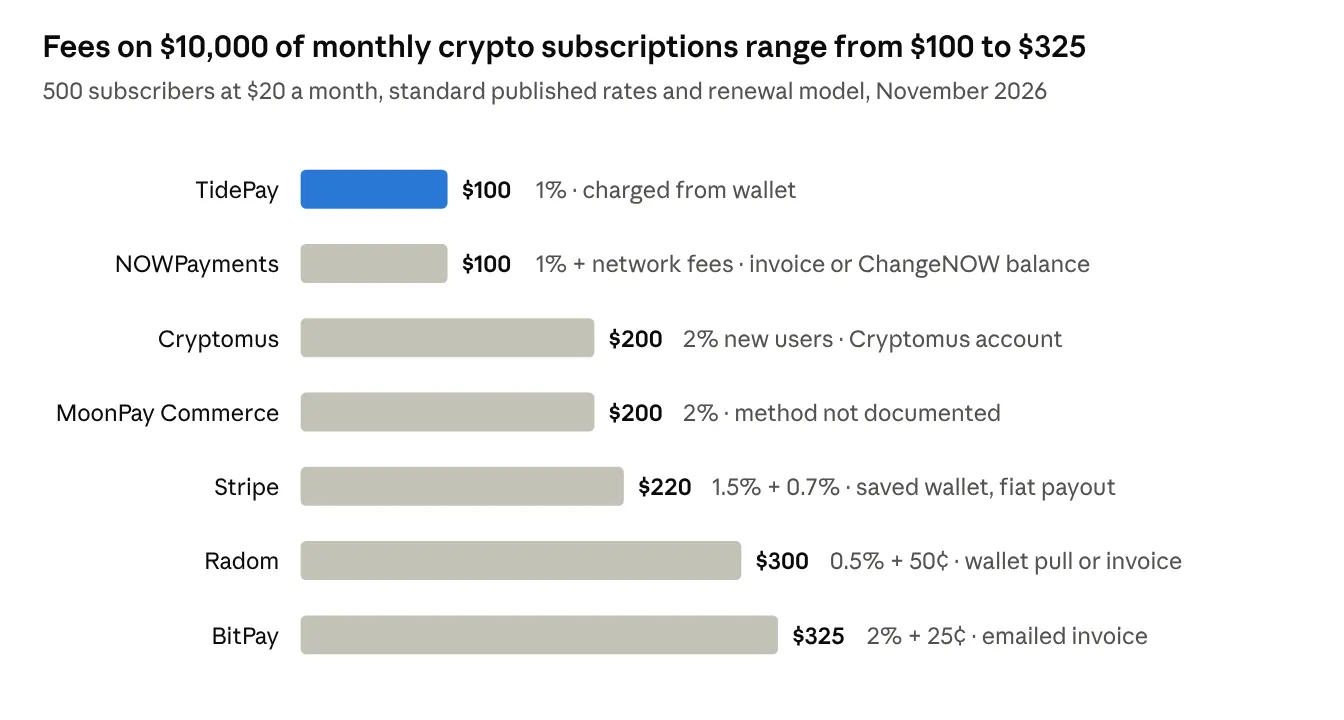
Standard published rates on each company's site, November 2026. Cryptomus at its new-user rate; network fees not included except where noted.
The two cheapest options at this size, TidePay and NOWPayments, renew in very different ways: one charges the wallet, the other emails an invoice or needs a ChangeNOW balance. Fixed per-charge fees push Radom and BitPay up on a $20 plan.
How to choose
Decide the renewal model first. If you want renewals without customer action and without asking them to open another account, you need a wallet-charging gateway: TidePay, Stripe (in preview) or Radom.
Decide what you want to receive. Stablecoins in your own wallet (TidePay), fiat (Stripe, or BitPay and Radom with conversion), or a crypto balance you withdraw from (Cryptomus, BitPay).
Check your plan price against fixed fees. On a $10 plan, BitPay's 25¢ adds 2.5 points and Radom's 50¢ adds 5 points. Percentage-only pricing (TidePay, NOWPayments, Stripe) is kinder to small plans.
Check availability. Stripe's stablecoin subscriptions are limited by country and still in preview.
Match your audience's coins. If customers want to pay in BTC or altcoins, an invoice-based gateway with many coins may convert better than a stablecoin-only one, even if fewer renewals happen on their own.
What a failed renewal looks like
Ask every provider what happens when the customer's wallet is short. TidePay marks the subscription past due, retries the charge for 7 days, then cancels it and fires a webhook so your app can act. With invoice-based billing, a failed renewal is usually just an unpaid email.
FAQ
What is the best crypto payment gateway for subscriptions?
For automatic stablecoin renewals that land in your own wallet, TidePay. For US companies already on Stripe who want fiat, Stripe's stablecoin subscriptions. For accepting many coins with invoice-style billing, NOWPayments, Cryptomus or BitPay.
Can crypto subscriptions renew automatically?
Yes. Gateways that charge the customer's wallet, like TidePay and Stripe, renew without the customer doing anything after the first approval. Others renew from an account balance or send an invoice each period.
Which crypto subscription gateway has the lowest fees?
On a $20 plan, TidePay and NOWPayments both charge 1%. Radom's 0.5% is lowest in percentage terms but adds 50¢ per charge, so it only wins on plans above about $100 a month.
Do my customers need an account to pay a crypto subscription?
It depends on the gateway. With TidePay, Stripe and Radom's wallet pulls, customers only need a wallet. Cryptomus requires a Cryptomus account, and NOWPayments' automatic mode requires a ChangeNOW account.
Are crypto subscriptions safe for customers?
The safest models let the customer see and limit what can be charged. With TidePay, the customer signs a maximum per charge and a minimum interval, and can revoke the approval from their wallet at any time.
Start crypto subscriptions with TidePay
Create a free TidePay account, set up a plan in USDC, and share a paylink. Read more about recurring billing on TidePay. You pay 1% per successful charge and nothing else.