6 min read
TidePay vs Superfluid: Pull Billing vs Payment Streaming
TidePay vs Superfluid: per-second payment streams or a charge each cycle? How each model works, what it costs and which fits your subscriptions.
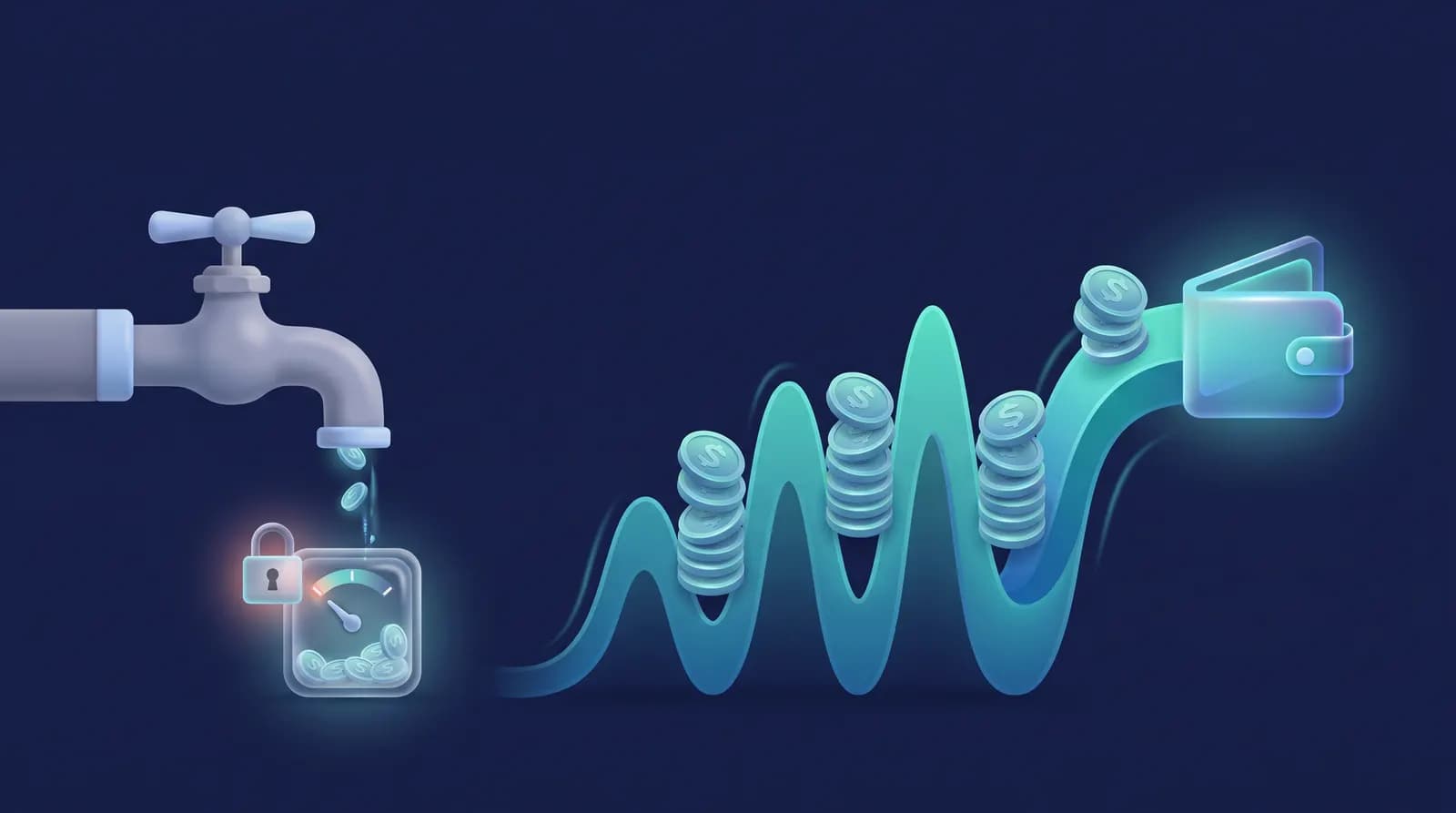
Superfluid and TidePay both let a customer pay you on an ongoing basis without signing a new transaction every month. They do it in opposite ways. TidePay vs Superfluid is really pull billing vs payment streaming:
Superfluid streams money. The customer opens a stream, and tokens move from their balance to yours every second at a fixed rate until someone stops it or their balance runs out.
TidePay pulls a charge each cycle. The customer approves the subscription once, and TidePay charges the full amount at each renewal date, like a card subscription.
The short verdict
Pick Superfluid if you're building on-chain and value-per-second matters: payroll, vesting, pay-as-you-go access, rewards distribution, or protocols paying each other. It's an open, non-custodial protocol you integrate yourself.
Pick TidePay if you sell plans with a price per month or year (SaaS, memberships, paid communities) and want a ready-made billing product that charges stablecoins from the customer's normal wallet balance.
Last checked: November 16, 2026. Superfluid facts come from its own docs, help center and blog.
How Superfluid payment streaming works
From Superfluid's money streaming docs: "tokens are continuously transferred from a sender to a receiver at a defined per-second rate." A rate of 100 USDCx a month is about 0.0039 USDCx per second. Opening or changing a stream is one transaction; balances then update every second without more transactions.
Three mechanics matter for subscriptions:
Super Tokens. Streams use Super Tokens. To stream USDC, the customer first wraps it, which "locks ERC20 assets in the wrapper contract and issues an equal amount of Super Tokens" (glossary), for example USDC into USDCx. The money being streamed is the wrapped balance, not the customer's regular USDC.
Buffer deposit. When a stream opens, a deposit is locked as a reserve. Superfluid's help center puts it at "4 hours' worth of the streamed asset" on most mainnets.
Liquidation. If the sender's Super Token balance reaches zero, the account becomes critical, and Sentinels (external operators anyone can run) close the stream and can claim the buffer as a reward. "If you allow your Super Token balance to reach zero, you will lose the buffer."
Superfluid Subscriptions
In April 2023, Superfluid announced Subscriptions: an "open-source, zero fees toolkit" that is "non-custodial and self-hosted," with a checkout widget where users create, update and cancel subscription streams. The announcement listed Polygon, Optimism, Arbitrum, Avalanche, BNB Chain, Gnosis Chain and Celo. Your app checks whether an address is currently streaming to you and listens for events when a stream is deleted or changed (subscriptions docs).
The subscription is the stream itself: while it flows, the customer is subscribed; when it stops, they aren't.
How TidePay pull billing works
TidePay works like a card subscription, on-chain. The customer opens your paylink or checkout, connects their wallet and approves the subscription once. On EVM networks they also sign the terms: the maximum per charge, the minimum interval and the fixed list of payees, which TidePay's contract enforces. On Solana, charges run through the @solana/subscriptions program.
At each renewal date, TidePay charges the plan amount from the customer's regular USDC, USDT or EURC balance and sends it to your wallet in one transaction. Nothing has to be wrapped, nothing is locked as a deposit, and TidePay never holds the funds.
Failed renewal: the subscription goes past due and TidePay retries for 7 days before canceling, with a signed webhook at each step.
Cancellation: now or at period end, so a customer keeps what they paid for; they can also revoke the approval from their wallet.
Billing features: plans, trials, billing cycle anchors, customer portal, signed
subscription.*andpayment.*webhooks, split payments to up to 10 wallets, Discord roles and Telegram groups.Networks and tokens: USDC and USDT on Polygon, Arbitrum, Base, Optimism and Solana; EURC on Base and Solana.
Pricing: 1% per successful charge (0.8% above $25K a month), no monthly fee. TidePay covers gas on automatic renewals; on one-time payments the payer covers gas.
Pull billing vs payment streaming side by side
Superfluid | TidePay | |
|---|---|---|
Model | Continuous per-second stream | One charge per billing cycle |
When you get paid | Every second, as the stream flows | Full plan amount at each renewal |
Customer's tokens | Wrapped into Super Tokens (USDC → USDCx) | Regular USDC, USDT or EURC |
Deposit | Buffer locked at stream start (about 4 hours of flow on most mainnets) | None |
Balance runs out | Stream liquidated by Sentinels; customer loses the buffer | Past due, 7 days of retries, then canceled |
Customer stops paying | Deletes the stream at any second | Cancels now or at period end, or revokes approval |
Billing features | Toolkit and widget; your app tracks streams and events | Plans, trials, anchors, portal, webhooks, sandbox |
Fees | Subscriptions toolkit described as "zero fees" | 1% per charge (0.8% above $25K/month), gas covered on renewals |
Networks (subscriptions) | Polygon, Optimism, Arbitrum, Avalanche, BNB Chain, Gnosis, Celo (2023 list) | Polygon, Arbitrum, Base, Optimism, Solana |
Integration | Open protocol you integrate and host | Hosted product with paylinks, checkout and API |
What a month looks like
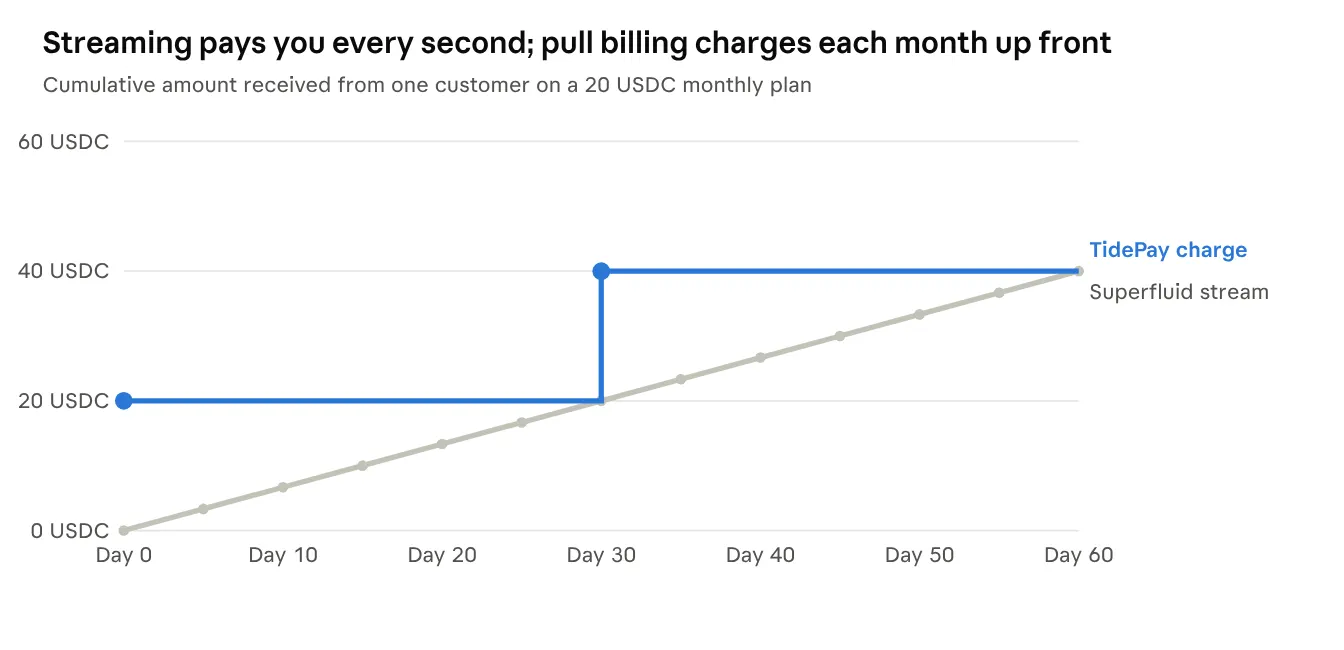
With a stream, a customer who cancels on day 12 has paid for 12 days. With pull billing, they've paid for the month and keep access until it ends. The first is fairer for usage-based access; the second is what customers expect from a plan priced per month.
Where Superfluid is the better choice
Value that accrues by the second. Payroll, contributor pay, token vesting, grants and rewards distribution, where paying for exactly the time used is the point.
Pay-as-you-go access. Usage that starts and stops anytime, such as metered APIs or rentals, where a monthly plan would over- or under-charge.
Protocol-to-protocol payments. DAOs and on-chain apps paying each other continuously, with no billing product in the middle.
No platform fee. The subscriptions toolkit is described as open source and "zero fees"; you only pay gas to open, change or close a stream.
Composability. Streams are on-chain objects other contracts can read and react to.
Where TidePay is the better choice
Plans priced per month or year. SaaS, memberships, courses and paid communities, where customers expect to pay a fixed amount per period, like any other subscription.
No wrapping, no deposit. Customers pay from their regular USDC, USDT or EURC balance. They don't have to wrap tokens or keep a buffer locked.
Gentler failures. An empty wallet means a past-due subscription and 7 days of retries, not a liquidated stream and a lost deposit.
You're paid in advance. Each renewal brings in the full period up front, which is easier for accounting and refunds than a balance that grows by the second.
Billing already built. Trials, cycle anchors, customer portal, webhooks, split payments, Discord roles and Telegram groups, plus a sandbox that fast-forwards renewals.
Networks. TidePay subscriptions run on Polygon, Arbitrum, Base, Optimism and Solana. Check Superfluid's current network list against the chains your customers use.
FAQ
What is the difference between payment streaming and pull billing?
Payment streaming moves money every second at a fixed rate for as long as the stream is open. Pull billing charges the full amount once per billing cycle, from an approval the customer gave once. Superfluid streams; TidePay pulls.
Is Superfluid good for subscriptions?
For subscriptions where paying per second makes sense, yes, and its toolkit is open source with no platform fee. For plans priced per month, customers need to wrap tokens and keep a balance above zero, or the stream is liquidated and they lose the buffer deposit.
What happens if a customer runs out of funds?
On Superfluid, the account becomes critical, Sentinels close the stream and can claim the buffer. On TidePay, the subscription goes past due and TidePay retries for 7 days before canceling.
Do customers need to wrap USDC to subscribe with TidePay?
No. TidePay charges regular USDC, USDT or EURC from the customer's wallet. Superfluid streams use Super Tokens, so USDC is wrapped into USDCx first.
Can I use Superfluid and TidePay together?
Yes. A common split is Superfluid for contributor pay or usage-based access, and TidePay for customer plans priced per month or year.
Try pull billing for your subscriptions
Create a free TidePay account, set up a monthly plan in USDC, and share a paylink. Read more about recurring billing on TidePay. You pay 1% per successful charge and nothing else.